

What Does Real Support for Women Look Like?
If you ask most Pennsylvanians what a woman facing an unexpected pregnancy needs, the answer is usually not complicated. She needs accurate information. She needs time to think. She needs support she can trust. She needs to know what resources are available to her and her child. She needs people willing to walk alongside her. It may be a difficult decision, but it is one that has the potential to bring great joy and blessings to her through the gift of life.
That is why we must pay attention to what’s unfolding in Pennsylvania right now.
Across our Commonwealth, pregnancy resource centers provide exactly that kind of support every day, free of charge. But, at the very same time, Planned Parenthood and the abortion industry are pursuing a very different agenda. They are lobbying Harrisburg to eliminate Pennsylvania’s 24-hour informed consent waiting period, seeking special exemptions from health and safety requirements such as Rh testing protections, and misleading the public about the services they provide.
The contrast raises an important question: what does genuine care for women truly look like? These are not merely competing policy proposals. They represent two fundamentally different worldviews and visions of what it means to care for women.
The Quiet Work Happening in Communities Across Pennsylvania
Most Pennsylvanians will never see the headlines generated by pregnancy resource centers. They are not organizing rallies or issuing press releases celebrating their latest lobbying victories.
Instead, they are hard at work.
A young woman discovers she is pregnant and isn’t sure where to turn. A pregnancy center provides a free pregnancy test, an ultrasound, offers information about fetal development, and answers her questions.
A first-time mother is worried about how she will afford diapers, formula, or a crib. A pregnancy center connects her with practical assistance and community-donated resources.
A couple feels overwhelmed by the prospect of becoming parents. They are offered education, mentoring, and support that continues long after the baby is born.
This work is happening every day in communities throughout Pennsylvania.
As was shared on Monday at this year’s PPWC Day at the Capitol, pregnancy resource centers are actively filling important gaps by providing pregnancy confirmation, education, practical support, parenting resources, referrals for prenatal care, and ongoing assistance throughout pregnancy and the postpartum period.
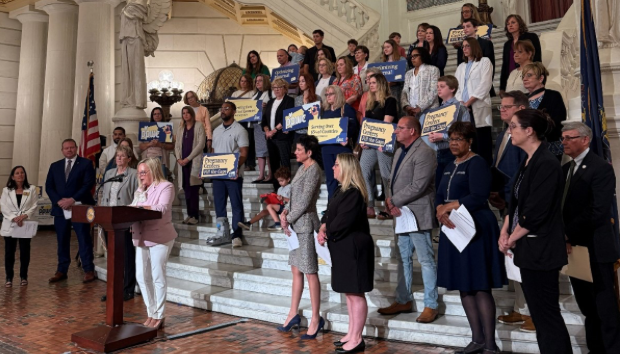
While Planned Parenthood uses “filling the gaps” as political sloganeering, many women receive these services from pro-life pregnancy resource centers at no cost, removing barriers that might otherwise prevent them from getting life-affirming help when they need it most.
Real care for women facing unexpected pregnancies requires honest medical information and education essential for true informed consent and essential to encourage women to make life-affirming choices. They need someone willing to answer questions honestly, explain available options, and help them understand the support they have for both them and their children.
Planned Parenthood Has a Different Priority
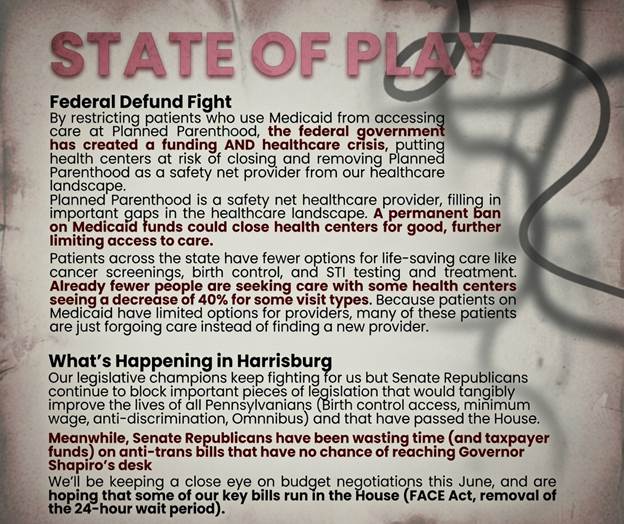
While pregnancy centers are working to expand support and information, Planned Parenthood is pursuing a very different agenda in Harrisburg. In a recent legislative update distributed to supporters, Planned Parenthood Pennsylvania Advocates identified a key priority they hope lawmakers will advance this year: elimination of Pennsylvania’s 24-hour waiting period before an abortion and the mandated “Alternatives to Abortion” counseling.
The effort to eliminate the waiting period and counseling deserves particular attention because it goes directly to the question of informed consent.
Currently, Pennsylvania’s law requires a woman to receive certain information and then be given time before an abortion can be performed to ensure informed consent. The purpose is straightforward. Decisions involving both a woman’s health and the life of an unborn child deserve thoughtful consideration, not pressure, haste, or incomplete information.
Yet, this week, Planned Parenthood representatives mocked these protections as “ridiculous Alternatives to Abortion counseling” during their quarterly Zoom call with supporters. That statement reveals a great deal about how the abortion industry views informed consent.
The counseling and information requirements that Planned Parenthood dismisses are exactly what pregnancy resource centers provide every day. Pregnancy resource centers routinely offer medically accurate information, educational resources, ultrasound confirmation, referrals, and the opportunity for women to ask questions and understand all their options before moving forward. In other words, the very process Planned Parenthood portrays as unnecessary is often exactly what women say they need.
When an organization views additional information as a problem, it raises an important question: Who benefits when women have less time and fewer opportunities to consider their options?
Asking for Special Treatment
The push to eliminate the waiting period is not the only example of the abortion industry’s efforts to weaken safeguards for women. Planned Parenthood is also asking Pennsylvania officials for an exception to existing Rh testing requirements associated with abortion procedures.
Pennsylvania law requires this testing because Rh incompatibility can create serious complications in future pregnancies. These safeguards exist for a reason. They were adopted to protect women and preserve future reproductive health.
Yet rather than following the same standards established in state law, Planned Parenthood is seeking an exemption, putting women at serious risk.
Unfortunately, this follows a familiar pattern. Time and time again, abortion-industry advocates argue that regulations, reporting requirements, inspection standards, counseling requirements, and informed consent protections should be reduced, waived, or even eliminated . It’s almost like they don’t want women to make an informed choice.
The justification changes. The direction never does. The result is always fewer safeguards for women and greater convenience and profit for abortion providers.
Pennsylvania has already seen the dangers of regulatory complacency. The Gosnell scandal exposed what can happen when government officials stop holding abortion facilities accountable and begin treating them as exceptions to the rules. The lesson from that tragedy should not be forgotten.
Women deserve accountability and transparency, not politically-connected, profit-driven industries lobbying for special treatment.
A Familiar Pattern of Deception
These latest lobbying efforts would be concerning enough on their own. They become even more troubling when viewed alongside Planned Parenthood’s repeated history of misleading the public.
In July of last year, Pennsylvania Family Institute documented how multiple Planned Parenthood locations in Pennsylvania were falsely advertising prenatal and postpartum services on their websites despite offering no prenatal care whatsoever. Our investigation confirmed what Planned Parenthood’s own staff acknowledged when contacted directly: not a single Planned Parenthood location in Pennsylvania provides prenatal care.
Not one.
Yet women searching online for pregnancy support could easily have concluded otherwise.
This was not a one-time mistake. Pennsylvania Family Institute exposed the same misleading claims in 2017, prompting Planned Parenthood to quietly remove the advertisements. Eight years later, the same false representations appeared again.
In December, we examined Planned Parenthood of Western Pennsylvania’s own newsletter and called out the striking disconnect between the organization’s public image and its actual priorities. While supporters often portray Planned Parenthood as an essential source of comprehensive women’s services, Planned Parenthood’s own reporting highlighted expanding abortion-industry activity while offering no evidence of meaningful prenatal support for women choosing to carry their pregnancies to term.
Taken together, these incidents reveal a pattern. Planned Parenthood’s public messaging falsely emphasizes broad concepts like care, access, and support. Its advertising, lobbying agenda, and internal communications tell a much different and deadly story for the unborn.
Women Deserve Better Than Dishonest Political Slogans
Pro-abortion advocates and lobbyists lean on fear-mongering and deceptive political slogans. But women facing unexpected pregnancies live in the real world.
They are thinking about relationships, finances, housing, childcare, employment, education, and family responsibilities. They are looking for people who will help them navigate complicated circumstances with honesty and compassion.
That is why pregnancy resource centers matter. They meet women where they are. They provide practical support. They offer information without rushing decisions or coercion. They continue walking alongside families long after a news cycle ends, and long after politicians move on to the next issue.
Save the Date: sixth annual Pennsylvania March for Life
Every heartbeat matters. Every life deserves love. 💕
Thousands of Pennsylvanians came together each year for the annual Pennsylvania March for Life—standing shoulder to shoulder in courage and boldness.
From every corner of our Commonwealth, families, students, pastors, and leaders marched to declare one simple truth: every human life, from conception to natural death, has immeasurable dignity and worth.
We march because compassion compels us to stand for both mother and child, for both the born and the unborn.
This is why we march. Join us on the steps of the Pennsylvania State Capitol on Monday, September 21, 2026.



I feel young woman need to complete their education and be able to financially support a child. Getting married and having 2 parents to raise the child is important to me. Family structure and support are necessary. Too many young men walk away from their responsibility that results in an innocent child growing up without a stable family.
,