By Josue Sierra
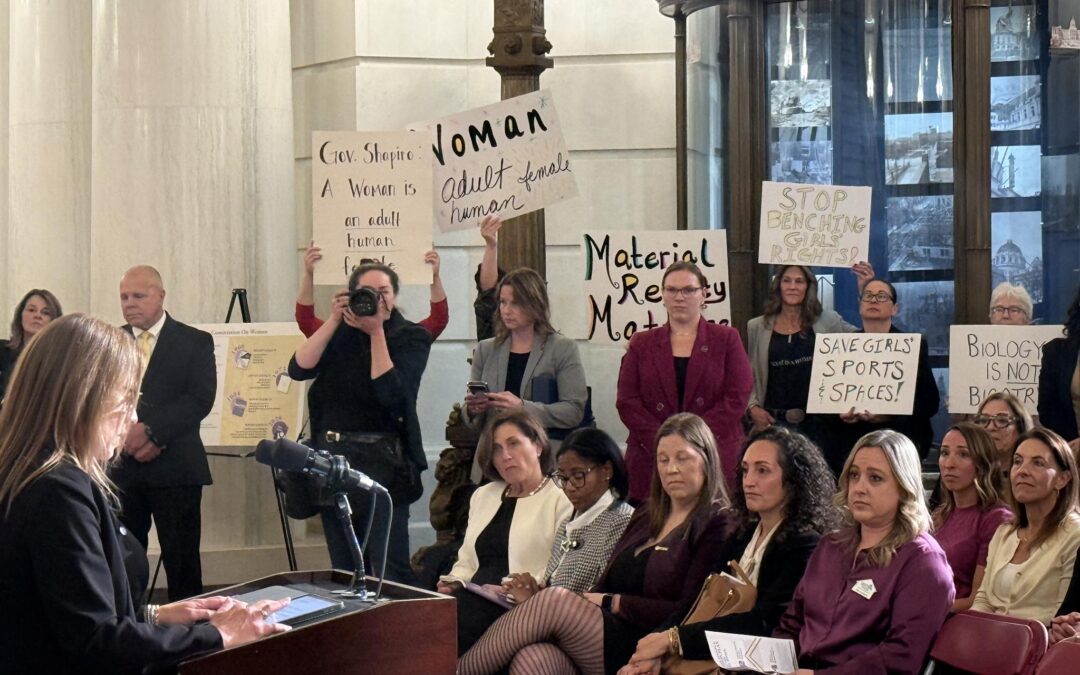
HARRISBURG, PA — The Shapiro administration unveiled Pennsylvania’s first comprehensive report on the status of women in more than 20 years on Tuesday, November 17. But as First Lady Lori Shapiro celebrated its findings in the State Capitol, women holding protest signs raised a basic question: How can state leaders defend women’s rights without defining what a woman is?
The 2026 State of the Woman Report, released by Governor Josh Shapiro’s Advisory Commission on Women, draws on 10,814 survey responses from all 67 counties and 252 participants at 13 listening sessions. It seeks to address child care, maternal health, economic security, workplace conditions, and violence against women.
Those are concerns. But the report’s own data reveal a contradiction at the heart of the administration’s approach.
On page 25, the commission reports that 0.28% of survey respondents identified as sex-rejecting males, so-called “transgender females.” In other words, a survey promoted as a measure of women’s experiences accepted respondents based on gender identity rather than limiting participation to actual women.
“How can a commission tasked with understanding and addressing women’s needs do its job if it cannot even define what a woman is?” ~ Emily Kreps
“The Shapiro administration claims to champion women, yet its own State of the Woman survey undermines the very definition of womanhood,” said Emily Kreps, who helped organize the protest. “How can a commission tasked with understanding and addressing women’s needs do its job if it cannot even define what a woman is?”
Behind the speakers, demonstrators displayed signs reading “A Woman Is an Adult Human Female,” “Biology Is Not Bigotry,” “Save Girls’ Sports & Spaces!” and “Stop Benching Girls’ Rights!” First Lady Shapiro repeatedly looked toward Kreps’s protest sign during the presentation.
“Listening is a form of leadership,” Commission Executive Director Ashley Walkowiak proclaimed. Yet as women stood just feet away challenging the administration’s rejection of biological reality, no speaker addressed their fundamental question: What is a woman? The administration claims to listen to Pennsylvania women, but is it willing to hear women who challenge its sex-rejecting radical gender ideology?
Perhaps most troubling was the commission’s effort to turn its survey results into a policy mandate. “The women of Pennsylvania were remarkably clear about what they need,” declared Executive Director Ashley Walkowiak, urging policymakers to implement the commission’s recommendations. Yet the report itself repeatedly acknowledges that its voluntary survey was not statistically representative of Pennsylvania women.
Despite knowing this limitation, the commission publicly presented its results as though they reflect the priorities of all women across the Commonwealth. That includes highlighting the claim that 85% of respondents support abortion access, even though the survey cannot and does not establish what Pennsylvania women generally believe about abortion. Consider that Gallup’s 2023 national polling found that 75% of American women oppose making late-term abortion generally legal in the final three months of pregnancy. A methodological disclaimer buried in a lengthy report does not justify public rhetoric that implies a statewide consensus the research cannot substantiate.
And what about the countless Pennsylvania women leading the pro-life movement, defending unborn children, and supporting mothers facing difficult pregnancies? Their voices and convictions deserve to be heard, too. The commission cannot acknowledge that its survey does not represent Pennsylvania women in the report, then publicly speak to the press as though it does from the Capitol podium.
Presenting self-selected survey responses as evidence of what Pennsylvania women want is completely unscientific and misleading, especially when those findings will likely be misused to justify harmful policies affecting the lives of unborn children, infringing on parental rights, and impacting families statewide.
The commission’s definition creates a separate problem. A report examining pregnancy, menopause, female safety, and sex-based discrimination depends on recognizing biological differences. Substituting sex-rejecting self-declared identity for sex obscures the distinctions policymakers must understand to address those issues accurately.
One of the major themes of the report was safety, and yet men competing in women’s sports was not mentioned.
Kreps pointed to the very real consequences we see here in Pennsylvania, “According to HeCheated.org, at least 73 instances of males competing in girls’ scholastic athletics have already been documented in Pennsylvania, undermining fairness and opportunities for female athletes.”
The contradiction became even more glaring when Commission Executive Director Ashley Walkowiak declared, “They are asking for systems that recognize their reality, value their contributions, and create genuine opportunity to succeed.”
Later, Walkowiak urged institutions to “do more to prevent violence, support survivors, and create pathways to safety and security.” Yet women who have experienced male violence have already spoken out about the trauma of being forced to share supposedly safe spaces with men. In Canada, a domestic violence survivor identified as “Jane” described encountering a male resident exposing himself inside a women’s shelter. “In my mind, I shut down. There was so much fear,” she recalled. In California, nine women filed a lawsuit alleging sexual harassment after a women’s homeless shelter admitted a male resident who identified as a woman into shared shower facilities. These women sought refuge and protection, not another setting in which their privacy, dignity, and trauma would be disregarded. How can an administration champion survivors while ignoring these experiences?
How can the Shapiro administration demand that institutions recognize women’s reality while its own commission refuses to recognize the biological reality of womanhood? How can it claim to champion women’s safety and fair opportunities while ignoring the threat to girls’ privacy, athletic opportunities, and sex-separated spaces when males are permitted to enter them? These are fundamental questions about whether Pennsylvania’s government will defend women’s distinct rights or sacrifice them to gender ideology.
Women cannot be protected by policies that refuse to recognize who women are.
“Women deserve more than political rhetoric,” Kreps said. “If Governor Shapiro is serious about protecting women, he should start by recognizing what makes women distinct and defending their rights, privacy, safety, and opportunities.”
For Pennsylvania’s women and girls, those protections must begin with an acknowledgment the demonstrators brought directly into the Capitol: biological sex matters, and public policy cannot protect women’s distinctive rights while pretending otherwise.
Visit pafamily.org/action to make your voice heard and tell your legislators to pass the Save Women’s Sports Act!
Related Video:
From the archives: In May of 2025, female athletes and state legislators took to the podium to tell their own personal stories, celebrate the passage of Senate Bill 9, and urge the House to take up the Save Women’s Sports Act – a crucial piece of legislation that would protect fairness and safety for female girls.