A review of New Jersey’s experience raises grave concerns about what could happen if Pennsylvania follows a similar path.
Governor Josh Shapiro says he wants to “codify” abortion, jeopardizing Pennsylvania’s current abortion limits and inviting an increase in the number of babies being intentionally killed by abortion. By a lot. We’ve already seen this happen, and all we have to do is look at a neighboring state.
States that “codify” abortion implement a regulatory system with virtually unlimited abortion and use taxpayers to help pay for it. These states have seen a sharp increase in abortion totals. New Jersey now performs 60,000 abortions, a 25% increase since 2020. In New York, some reports show a number that’s double NJ’s annual total.
If Pennsylvania codified abortion, as called for in the Democratic Party’s platform, and experienced the same 25% increase in abortions as New Jersey, there would be an increase of 20,000 more abortions in PA through 2030.
New Jersey’s Sad State of Affairs
New Jersey not only allows abortion at any stage in pregnancy but also has very few restrictions on abortions. In January 2022, New Jersey codified abortion into state law. By doing so, abortion is permitted at any time during pregnancy, and any limit on when, where, or how is virtually gone.
While the reporting of New Jersey’s abortion numbers varies since the state only reports on abortions in hospitals or ambulatory surgical facilities (not actual abortion facilities), reports show New Jersey recorded 59,780 abortions in 2024. This represents a 25% increase since 2020.
Laws influence culture. New Jersey now has at least 60 abortion locations, up from 48 in 2023. Those include ones that use telehealth to send abortion pills through the mail and forgo in-person consultations. There are already 18 telehealth-only abortion businesses in New Jersey. And they mail chemical abortion pills out of state.
Pennsylvania’s Future?
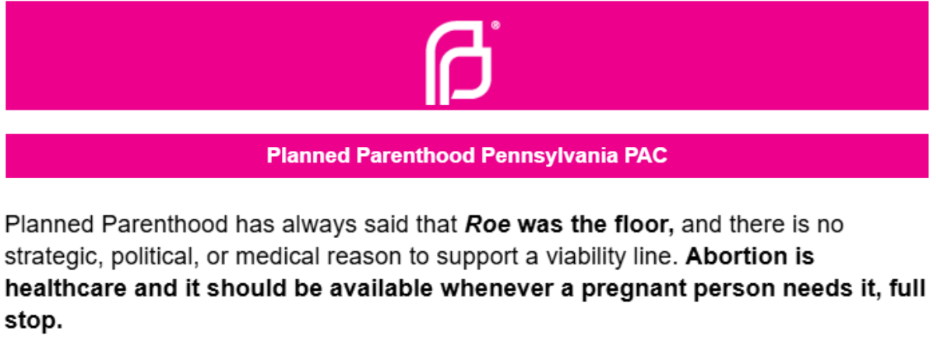
Democrat politicians in Harrisburg and their supporters in the abortion industry, including the largest abortion business – Planned Parenthood, want to follow states like New Jersey. Gov. Shapiro calls for codifying abortion and giving women the “full range of options” – meaning no limit on abortion should stand in someone’s way. The PA House Democrats have already passed bills in this session to chip away at Pennsylvania’s current limits on abortion.
There was a time when Pennsylvania was performing 60,000+ abortions. In 1980, the number of abortions in PA was over 65,000, eerily like where New Jersey is heading despite a smaller population than Pennsylvania.
The latest report reveals that Pennsylvania carried out 32,946 abortions in 2024.
If Pennsylvania were to enshrine abortion into our laws and sandblast our current limits on abortion, using PA’s 2024 number as a baseline* and the 25% growth seen in New Jersey from 2020 – 2024, it would produce the following projection:
| Year | Illustrative annual abortions | Increase over baseline |
| 2026* | 32,946 | — |
| 2027 | 34,837 | +1,891 |
| 2028 | 36,837 | +3,891 |
| 2029 | 38,952 | +6,006 |
| 2030 | 41,183 | +8,237 |
What this scenario illustrates:
- By 2030: Approximately 8,200 more abortions annually than the assumed baseline.
- Approximately 20,000 additional abortions between 2027 and 2030.
- Growth rate: 5.74% annually, compounded over four years.
These calculations assume similar demographics and a smooth growth rate. But the rise in chemical abortions is cause for even greater concern. Pennsylvania is likely seeing an increase in abortions from the 2024 numbers. And the numbers are projections. In New Jersey, the 2020-2024 period includes factors like the COVID-19 pandemic and the 2022 Dobbs decision overturning Roe v. Wade (only 5% of NJ’s 2024 abortion totals were on women from out of state).
But state laws matter. Laws limiting abortion make a difference. Here in Pennsylvania, current limits on abortion include:
- Limit to six months in pregnancy: Pennsylvania law generally restricts abortion after 24 weeks of pregnancy, subject to statutory medical exceptions.
- Parental consent for minors: Pennsylvania generally requires parental consent before a minor obtains an abortion. (The abortion industry continues to work around this through a judicial-bypass process.)
- Informed consent and waiting period: Pennsylvania law requires specific information to be provided before an abortion and generally imposes a 24-hour waiting period.
- Pre-procedure requirements and facility oversight: Pennsylvania has requirements for pre-procedure testing, and abortion facilities are subject to the health and safety standards of ambulatory surgical facilities. This was passed into law in 2012 in the wake of uncovering abortionist Kermit Gosnell and his House of Horrors licensed facility in West Philadelphia.
- Ban on taxpayer-funded abortions: Pennsylvania had a longstanding statutory restriction on using state Medicaid funds for most abortions, but this was declared unconstitutional by the Commonwealth Court in April 2026. The Pennsylvania Supreme Court is considering the appeal, but it declined to reinstate the restriction while the appeal proceeds. As of September 2026, Medicaid coverage for abortion services is available while litigation continues.
All these limits on abortion are at risk, both with the threat of a ruling by the PA Supreme Court declaring a so-called right to an abortion in our state Constitution, or if we codify abortion into Pennsylvania law.
Planned Parenthood PA, Governor Josh Shapiro, and the House and Senate Democrats want us to look more like New Jersey. That would be over 20,000 more abortions in Pennsylvania in the next four years.
Elections have consequences. Please vote accordingly.
To view the 2026 Voter Guide, go to PaFamilyVoter.com.
Paid for by Pennsylvania Family Council.