
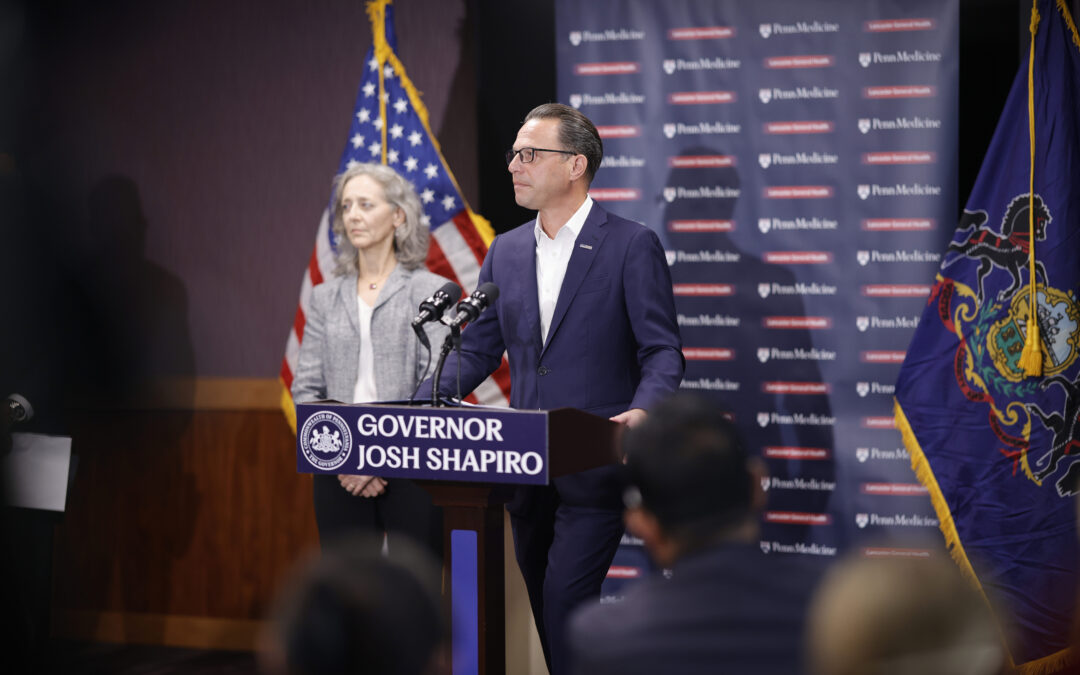
The Shapiro administration and Pennsylvania House Democrats have dismissed criticism of the Department of Health’s sweeping 502-page proposed rewrite of Pennsylvania’s disease regulations as “misinformation and fear.”
A spokeswoman for House Democratic Leader Matt Bradford went further, falsely telling the Mon Valley Independent: “No new authority is created in this proposal; it simply clarifies existing authority.” The Department of Health, of course, accused critics of trying to “scare Pennsylvanians.”
But don’t take our word for it. Look at who else is raising concerns.
This is neither misinformation nor Republican scaremongering. Concerns surrounding Regulation #10-242 come from school leaders, attorneys, journalists, homeschool advocates, and education leaders. Thousands of Pennsylvanians are raising serious questions about the impact the proposed regulations will have on parental rights, privacy and the scope of government authority.
Schools Caught Between Parents and Government
Perhaps the most significant warning comes from the Pennsylvania School Boards Association’s official comments–a non-partisan organization. PSBA submitted comments on behalf of more than 5,000 public-school directors and administrators. Its concern is remarkably direct:
“We are concerned that the proposed regulation places schools in an untenable position between parents and public health authorities.”
PSBA confirmed the parental rights overreach, specifically pointing to provisions requiring schools to provide government authorities access to students and permit private conversations during the school day while limiting school personnel’s ability to involve parents.
The association warns that the regulation could put school employees in “direct conflict with parental expectations” and specifically asks the Department to provide clear parental-notification requirements.
That is not partisan rhetoric. It is coming from a statewide public-school association. They’re simply asking what happens when government officials seek private access to students without parental involvement.
Christian Schools Are Raising the Same Alarm
Andrew Pry, executive director of the Pennsylvania Christian Education Network and a former public-school principal, told The Daily Wire that the regulations threaten the trust between parents and schools.
“As a former public-school principal, I know how essential trust between parents and schools is,” Pry said. “These regulations undermine that trust when it bypasses parents and gives unlimited access to the government to meet privately with our children.”
PCEN also formally submitted its concerns to the Independent Regulatory Review Commission, warning that the proposal would put Christian schools in conflict with the families they serve.
“Requiring schools to facilitate private government access to children while restricting parental involvement puts schools in direct conflict with the families they serve and undermines the trust essential to that relationship,” Andrew wrote.
Homeschool Families Are Paying Attention, Too
The Christian Homeschool Association of Pennsylvania (CHAP) has also alerted homeschool families about the proposal, warning cooperative and hybrid programs to pay particular attention to provisions allowing Department of Health officials to enter various locations during disease investigations. CHAP also points to what it describes as mounting pressure on homeschool families to provide private medical information and the subsequent publication of school-level vaccination data.
CHAP argues that the larger issue is parental authority:
“At the heart of this issue is a fundamental question of parental rights: To whom do the children in the Commonwealth of Pennsylvania belong? Through their actions, the Governor and many state legislators appear to treat children as wards of the state—suggesting that decisions about their health and safety should be made by bureaucrats rather than by the parents who know and love them best.”
CHAP concludes that “Families, not the state, bear the primary responsibility for decisions about the children entrusted to them.”
Attorneys Are Questioning the Government’s Reach
Jonathan Goldstein, a University of Pennsylvania Carey Law School lecturer and managing partner of Goldstein Law Partners, filed formal comments raising constitutional and privacy concerns.
In a Broad + Liberty op-ed, Goldstein argues that provisions involving entry into private property, private questioning of students, personal data, and disease-control measures need substantially clearer limits. He rightfully calls for warrant protections, parental notification, safeguards surrounding personal information, and clearer limits on government authority.
“As written, it lets the department pick ‘any other disease control measure’ it wants, whenever it wants, without asking anyone first. That is not a narrower rule. It is a blank check.”
The Independence Law Center raised similar constitutional concerns in formal comments filed with the Department of Health and IRRC. ILC specifically objected to provisions it says would give government officials broad access to students without parental involvement or notification, arguing that “parents have the fundamental right to make decisions concerning the care of their children.” The organization also warned that requiring religious schools to provide such access could conflict with their First Amendment rights when government officials discuss services contrary to the schools’ religious beliefs.
Drawing National Attention
Daily Wire investigative reporter Meg Brock was among the first national journalists to bring widespread attention to the proposed regulations. In her August 24 investigation, Brock affirmed that the proposal would expand Department of Health authority, “including the ability to enter homes and schools without a warrant, access confidential medical records, and impose statewide school mask mandates for disease prevention.”
Brock also reported that the proposal explicitly addresses private access to students, writing that it gives government officials authority “to meet and speak with a student or other person in private” while stating that school employees “may not obstruct” an investigation of a student.
Education advocate Beth Ann Rosica has separately argued that the controversy raises a broader question. Should consequential policy changes be made through administrative regulation or debated by elected legislators? She also highlighted the proposal’s replacement of terms including “woman” and “mother” with “individual” and “postpartum individual.”
Those language changes are not speculation. Live Action documented them, and Pennsylvania Family Council Chief Counsel Randall Wenger described the change as replacing biological terminology with language based on a different conception of sex and gender. Casey Harper, guest host for Family Research Council’s Washington Watch addressed the issue with Independence Law Center Chief Counsel, Randall Wenger.
The concerns surrounding these regulations cannot simply be dismissed as partisan “misinformation and fear.” They are being raised by public-school leaders, attorneys, journalists, Christian educators, homeschool advocates, and others examining questions involving parental rights, privacy, and the limits of government authority.
Take Action Before September 21
This regulation is not final, and the window for Pennsylvanians to respond is closing. Public comments on Regulation #10-242 must be submitted by Monday, September 21. Parents and concerned citizens have only days left to make their concerns part of the official public record.
TAKE ACTION: Submit your public comment at PAFamily.org/regulations
Related Video:



I’m not in favor of these new 502 page rewrite. Disrase regulations. Just say NO
I’m not in favor of the health departments new regulations for disease control. No more regulations.
I am strongly opposed to the proposed change to these regulations. This is total overreach. No!
I am strongly against 502-Page Health Regulation!!! As a taxpayer of Pennsylvania, I am against this invasion of privacy.
I am strongly against 502- page health regulation. I do not want my constitutional rights to be violated!
Stop this 502 page, life controlling regulation. No public meetings. Non
State government control. It takes are rights and privacy away from the people.stop this nonsense now. It’s democrats control.stop.Do what’s right for a change.
The citizens and parents of this commonwealth do NOT want bureaucrats and a rogue governor who are devoid of common sense and respect for the inalienable rights given to us by God to formulate regulations that attempt to override and negate these rights. We say NO to this proposed 502-page health regulation.
I am strongly against the new 502 page regulations. They are unconstitutional, unAmerican and immoral.
This government overreach into our private lives needs to stop. The government does not own our children. We the parents do!