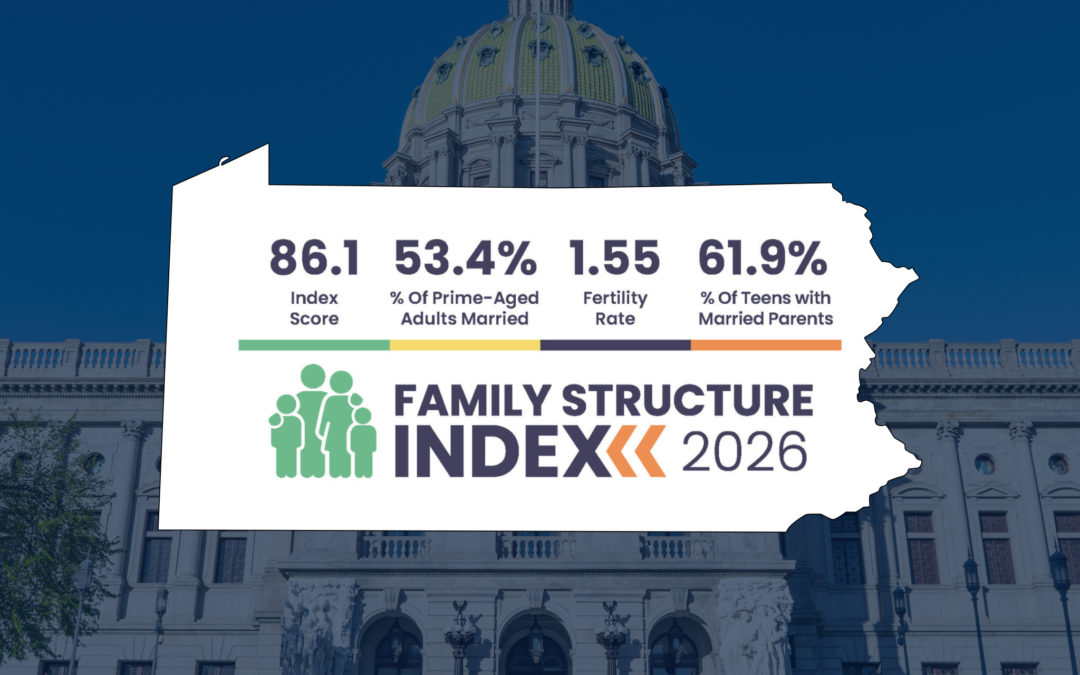
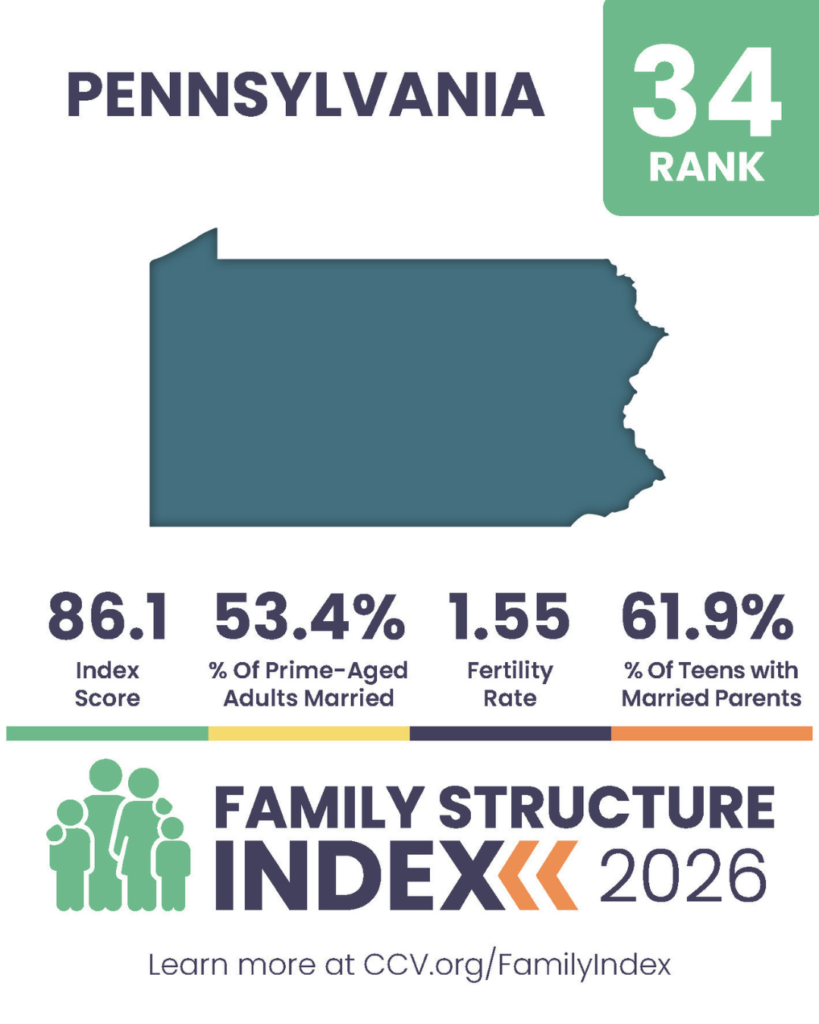
HARRISBURG, Pa. – Pennsylvania ranks 34th in the nation for family stability, according to the 2026 Family Structure Index (FSI), a national report released today by the Center for Christian Virtue and the Institute for Family Studies.
The Index measures the strength and stability of family life in all 50 states, offering a clear snapshot of how family trends are shaping outcomes for children, communities, and local economies. The full report is available here.
“Strong families really are at the center of a healthy society,” said Michael Geer, President of the Pennsylvania Family Institute. “When marriages are supported and children grow up in stable, caring homes, it makes a real difference—our communities feel safer, our economy does better, and the next generation has a stronger start. That’s why investing in marriage and family matters so much for Pennsylvania’s future.”
Family Structure Index evaluates three key factors: marriage rates among adults aged 25 to 54, fertility patterns, and the share of children raised by married parents. Together, these indicators provide a reliable picture of family stability and its connection to long-term well-being and the attainability of the American Dream.
Across the country, the report finds wide variation between states. Utah ranks first in family stability for the second year in a row, while New Mexico ranks last.
Key Findings for Pennsylvania:
- 34th overall ranking in family structure
- 61.9% of teens in Pennsylvania are raised by married parents
- 53.4% of adults (ages 25–54) are married
- 1.55 fertility rate and an overall index score of 86.1
“Family structure is one of the strongest predictors we have for whether children and communities are thriving,” said Brad Wilcox, Distinguished University Professor of Sociology at the University of Virginia and one of the report’s lead researchers. “States that are doing well in this area have markedly lower levels of child poverty, as well as higher rates of economic mobility and home ownership.”
The findings point to a consistent pattern: states with stronger families tend to see lower poverty rates, better educational outcomes, and safer communities. Conversely, declines in marriage and increases in single-parent households are closely tied to long-term economic and social challenges.
The report emphasizes that these trends are not set in stone, and that practical steps from policymakers and community leaders can make a real difference.
In response to these trends, Pennsylvania Family Institute today is also announcing a new statewide initiative, in partnership with Communio, to equip churches across Pennsylvania to strengthen marriages, support families, and renew their communities.
The effort will be deployed through Pennsylvania Family Institute’s Church Ambassador Network, a statewide network connecting thousands of pastors, positioning local churches to take the lead in addressing one of the most pressing challenges facing both the Church and society: the breakdown of marriage and family.
“Across Pennsylvania, pastors are seeing firsthand the strain on marriages and families,” said Kurt Weaver, Executive Director of the Pennsylvania Family Institute Church Ambassador Network. “Through our Church Ambassador Network, we are mobilizing churches to lead solutions in their communities. And this partnership equips them to do that with real, measurable impact.”
Through the initiative, churches across the Commonwealth will serve as catalysts for renewal, inviting couples and families into relationship-centered ministry, strengthening marriages, and building stronger, more stable communities.
“At Pennsylvania Family Institute and through the Church Ambassador Network, we believe the three primary spheres of authority are the church, the government, and the family,” added Weaver. “When families are strong, communities are more stable, neighborhoods are safer, and the burden on public systems decreases. This initiative in partnership with Communio allows churches to address challenges upstream, before they become crises.”
Communio, a national ministry specializing in relationship and marriage formation, will serve as a strategic partner, equipping churches with tools, data, and coaching to implement a proven, sustainable model of ministry.
Download the full report here.